

Many social media platforms, such as TikTok, Instagram, Snapchat, and YouTube, are often framed as having no concern for child safety. These platforms have been pushed to implement built-in safety systems designed to protect younger users. These include content filters, restricted messaging, warning prompts, search blocking, and wellbeing tools meant to reduce exposure to harmful material. Many of these platforms promote these features as a means to assure the public that they are proactive in keeping kids safe, typically in response to the trending stories of child grooming and abuse online.
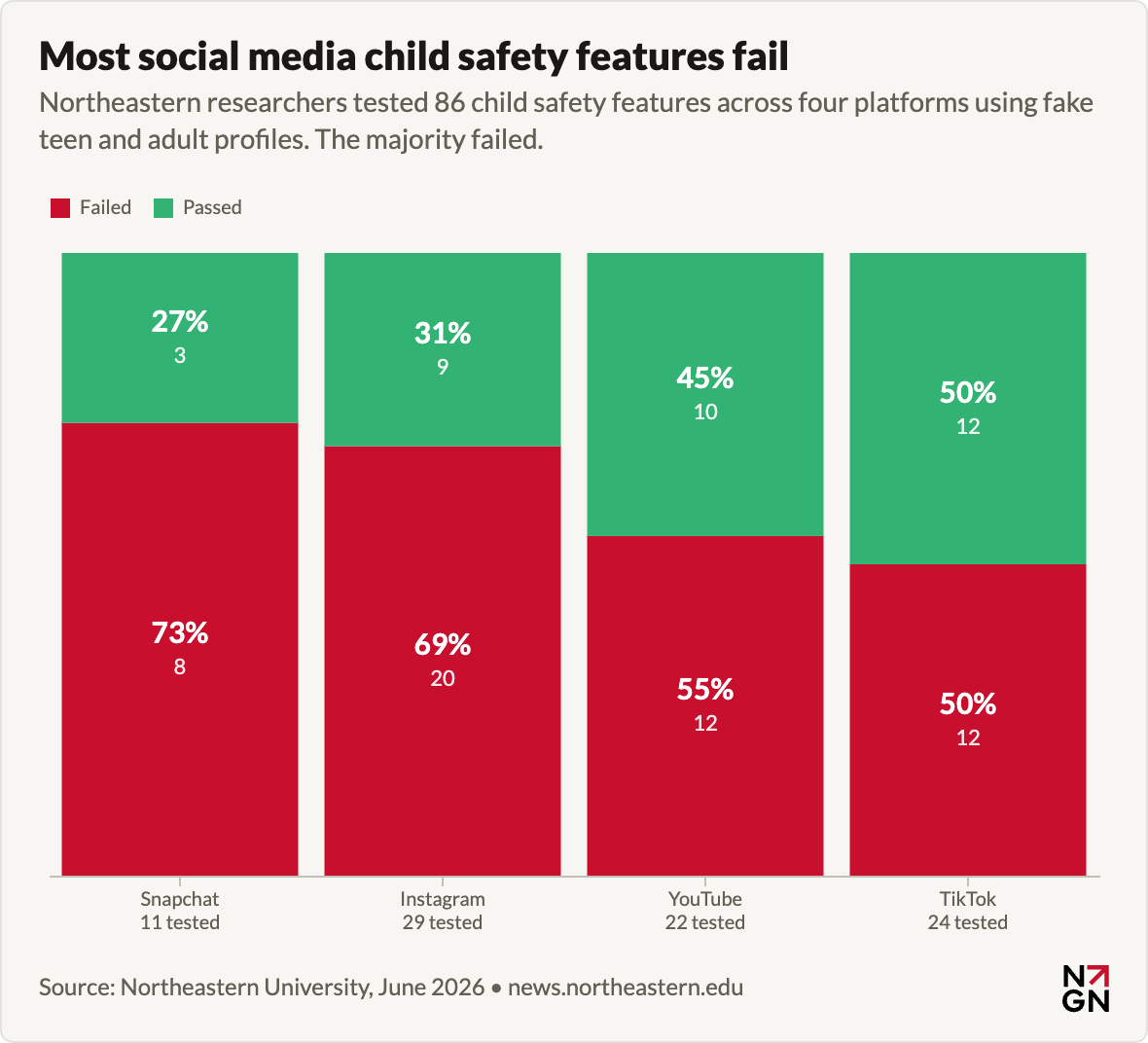
On paper, these systems suggest that platforms have made significant progress in protecting kids online. Recent research from Northeastern University and the Cybersafety Research Center suggests a more complicated reality. One of the studies showed that out of 86 youth safety features tested across major platforms, only 35 worked as intended under real use. The rest failed, were inconsistent, or could be bypassed easily by tech-savvy teens. That gap between safety features that exist and actually work in practice is becoming the center of the debate.
https://news.northeastern.edu/2026/06/29/social-media-safety-child-research/
What Was Tested
The studies evaluated safety tools across platforms including TikTok, Instagram, Snapchat, and YouTube. Researchers used test accounts as minors and adults, then evaluated whether safety systems worked in real scenarios. They were judged on whether they functioned as described, appeared during normal use, and could withstand typical teen behavior patterns. The conclusion was that many are not consistently effective when stress-tested against real user behavior.
Harmful Content Can Still Surface
Even when platforms are designed to block or redirect searches involving self-harm or eating disorders, researchers found that some systems still suggested harmful or adjacent content to accounts registered as minors. In some cases, teens weren’t actively searching for this content. The auto-complete functions were suggesting variations of the content. That shifts the issue from what kids are searching up vs what the platform is suggesting to them.
Why Safety Features Don’t Hold Up in Practice
One of the studies categorized failures into three main groups. Some features were missing even when researchers followed official instructions. Others were broken, meaning they existed but didn’t work as intended or were easy to bypass. A large portion was buried, meaning they were technically available but not easily accessible. The issue is that protection is dependent on users actively finding and enabling it. Most kids and teens don’t experience platforms that way. They experience them as continuous feeds and interactions without safety filters by default.
Safety vs. Engagement
The research highlights the flaws in platform design. These platforms are not just communication tools to share creativity. They are designed to keep users engaged with the content. Recommendation systems prioritize relevance and retention. Content flows are optimized for continuous interaction. Safety features are an addition to the experience instead of being embedded. Even when protections exist, they compete with the core design of how the platforms prioritize and suggest content. This creates inconsistency. Safety tools can work in isolation, but not always at scale with how users actually experience the platforms.
Why This Is Becoming a Policy Issue
These findings are part of a growing global conversation around regulation, lawsuits, and platform accountability. Governments and researchers are circling the same question. If safety features exist but don’t reliably work in real conditions, what does platform safety actually mean? That question is increasingly debated in courts, legislatures, and public policy discussions across multiple countries with the rise of online predator cases being associated with popular platforms like Roblox. The United Kingdom and Australia implemented regulations that ban social media for users under a certain age, the justification being child safety online. Many people argue that regulations like this make it worse for kids, and some even say the ulterior motive is stricter regulation for the internet overall.
The Millennial Parent Insight
For millennial parents, this is the modern version of an old internet problem. We grew up in environments where safety tools barely existed. We learned to bypass early safety systems that social media had at the time. Our parents were always concerned about who we talked to, what we saw online, and the constant dangers of predators. We had to learn how to navigate the dangers firsthand because there was no guide. Our exploration, experiences, and practices ultimately became the foundation for social media and internet culture that our kids and future generations will explore. Today’s platforms do have safety systems that are arguably stronger than what we had, but the issue is their inconsistencies. The important thing we can do as parents is to teach our children digital literacy. They need to know how to navigate the internet with their own critical thinking skills for their own benefit of entertainment and education online. The safety features reinforce their digital exploration when they possess strong digital literacy skills.
Final Thoughts
The research doesn’t suggest that safety tools are meaningless.
Some protections do work well when they are default-based or structurally embedded into the experience. It shows that opt-in or reactive safety systems are less reliable in real-world conditions. This circles back to whether safety is something users turn on or something built into the system. The studies suggest that having systems on by default is more likely to benefit young users in the long term.
We see something like this with Roblox's newly released age-based accounts and experience. Social media platforms have invested heavily in youth safety tools over the past decade. The challenge is making sure they actually hold up under real usage, real behavior, and real-world pressure. Kids, safety doesn’t happen in settings menus. It happens in combination with how they are taught to navigate the internet and is reinforced by default settings that embed safety into the experience.